
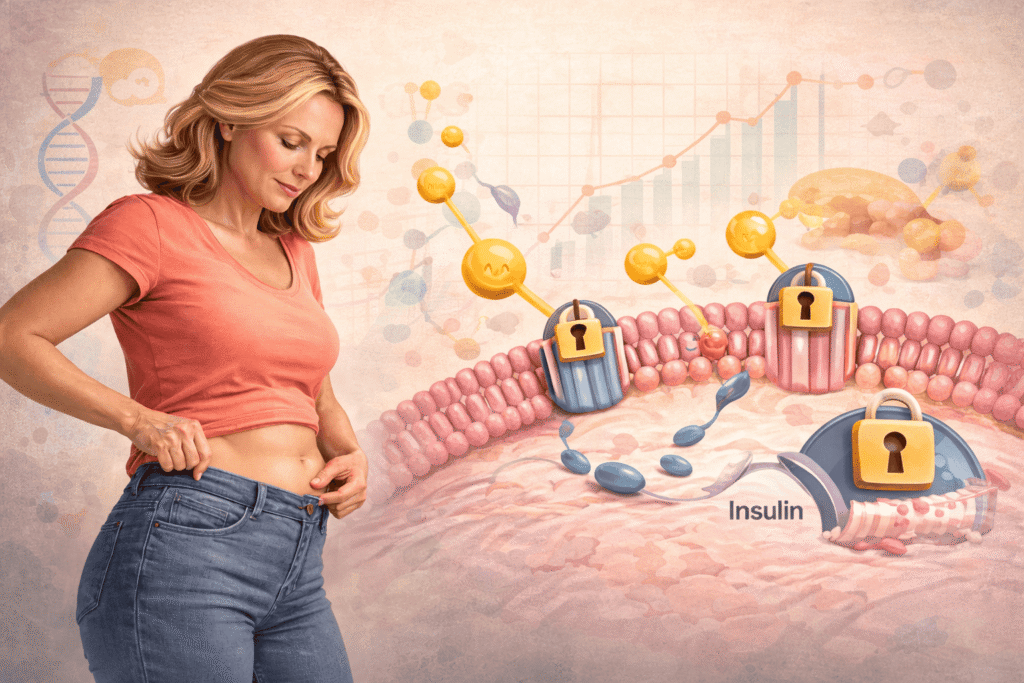
Insulin resistance in women over 40 often develops quietly.
You may not notice it at first.
You may simply feel more tired.
You may struggle with stubborn belly fat.
You may crave sugar more often.
But underneath these symptoms, your metabolism may be shifting.
Hormonal changes during perimenopause and menopause play a direct role in how your body handles glucose and insulin.
If you haven’t read our foundational guide yet, start here:
➡ Blood Sugar and Menopause: A Practical Guide for Women 40+
What Is Insulin Resistance?
Insulin resistance happens when your cells stop responding efficiently to insulin.
Insulin is the hormone responsible for moving glucose from your bloodstream into your cells, where it’s used for energy.
When cells become resistant:
- Blood sugar levels rise
- The pancreas produces more insulin
- Fat storage increases
- Energy becomes unstable
Over time, this can increase the risk of:
- Prediabetes
- Type 2 diabetes
- Visceral fat accumulation
- Metabolic syndrome
According to the National Institutes of Health, insulin resistance is closely linked to hormonal shifts and increased abdominal fat in midlife women.
Why Insulin Resistance Becomes More Common After 40
After 40, several physiological changes occur:
- Estrogen declines
- Muscle mass decreases
- Stress load increases
- Sleep quality often worsens
Estrogen supports insulin sensitivity.
When estrogen fluctuates during perimenopause, insulin signaling can weaken.
Additionally, muscle tissue is a major glucose-absorbing tissue.
When muscle mass declines with age, glucose regulation becomes harder.
These combined factors increase the likelihood of insulin resistance in women over 40.
7 Early Signs of Insulin Resistance in Women Over 40
Recognizing early signs allows you to intervene before blood sugar levels rise significantly.
1. Stubborn Belly Fat
Abdominal fat that increases despite similar eating habits is a common early indicator.
Insulin promotes fat storage.
When levels remain elevated, fat accumulation around the midsection becomes easier.
2. Energy Crashes After Meals
If you feel tired one to two hours after eating, blood sugar instability may be involved.
Large glucose spikes followed by rapid drops can cause fatigue.
Stable insulin improves steady energy.
3. Increased Sugar or Carb Cravings
Frequent cravings may signal poor glucose regulation.
When blood sugar drops quickly, the brain demands fast energy.
This creates a cycle of spikes and crashes.
4. Brain Fog
Mental clarity often depends on stable glucose delivery to the brain.
Fluctuating blood sugar may contribute to:
- Difficulty concentrating
- Irritability
- Forgetfulness
5. Waking Up at 3 AM
Many women over 40 wake up at night consistently.
This can sometimes be linked to blood sugar dips or cortisol spikes.
We’ll explore this deeper in an upcoming guide: The 3AM Wake-Up: Blood Sugar or Cortisol?
6. Increased Hunger Despite Eating Enough
Insulin resistance reduces metabolic flexibility.
This can impair your ability to access stored fat between meals, increasing hunger signals.
7. Difficulty Losing Weight Despite “Doing Everything Right”
You may be eating clean.
You may be exercising regularly.
But if insulin remains elevated, fat burning remains suppressed.
This is not a willpower issue.
It is a metabolic signaling issue.
How to Test for Insulin Resistance
Common markers include:
- Fasting glucose
- Fasting insulin
- HOMA-IR
- A1C
Discuss these tests with a healthcare provider.
Early awareness allows earlier intervention.
Harvard Health also emphasizes strength training as a powerful way to improve insulin sensitivity in midlife adults.
How to Improve Insulin Sensitivity After 40
Insulin resistance in women over 40 is often reversible with consistent adjustments.
Here are key strategies:
1. Strength Training
Muscle improves glucose disposal dramatically.
Even two sessions per week help.
2. Adequate Protein Intake
Protein slows glucose absorption and supports muscle preservation.
We’ll cover this fully in:
“Protein and Blood Sugar: How Much Is Enough After 40?”
3. Walking After Meals
Light movement improves glucose uptake without stress.
Even 10–15 minutes can reduce spikes.
4. Sleep Optimization
Poor sleep reduces insulin sensitivity even in healthy adults.
Prioritize consistency and darkness.
5. Stress Management
Chronic cortisol elevation worsens glucose control.
Breathing exercises and resistance training together can reduce this effect.
Can Supplements Help with Insulin Resistance?
Lifestyle remains foundational.
However, some ingredients may support:
- Glucose metabolism
- Insulin signaling
- Inflammatory balance
We analyze supplements transparently, focusing on evidence and realistic expectations.
See our in-depth review:
➡ Sugar Defender Review
Remember:
Supplements assist strategy.
They do not replace it.
Final Thoughts
Insulin resistance in women over 40 often begins subtly.
You are not failing your metabolism.
If you’re noticing signs of blood sugar imbalance, it may be worth looking beyond lifestyle changes alone.
Some supplements are designed to support healthy glucose regulation and metabolic function during midlife.
→ Learn more in our full review
Your metabolism is responding to hormonal shifts, muscle changes, sleep patterns, and stress.
The earlier you understand these changes, the faster you can adjust your strategy.
Stable blood sugar improves:
- Energy
- Fat metabolism
- Mood
- Inflammation
- Long-term metabolic health
And it starts with clarity.
Pingback: Estrogen and Insulin Sensitivity After 40
Pingback: Visceral Fat and Insulin Resistance Guide
Pingback: Cortisol, Stress and Blood Sugar in Menopause