
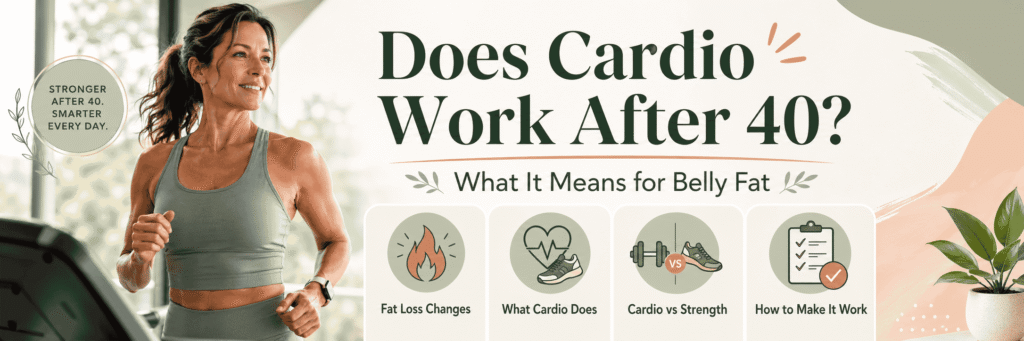
Cardio still matters after 40—but not in the way many women were taught to think about it. If you have been doing more cardio and still not seeing the changes you expected around your waistline, the issue is probably not effort. More often, it is that metabolism, hormones, muscle mass, recovery, and blood sugar regulation all start to matter more than simple calorie burn.
This article breaks down what cardio actually does, where it still helps, why it often falls short on its own, and how to make it work better if your goal is better energy, improved fitness, and less stubborn belly fat.
Quick Takeaways
👉 Cardio still supports heart health, energy use, and insulin sensitivity after 40.
👉 Cardio alone is often not enough for meaningful belly fat reduction.
👉 Strength training becomes more important because muscle mass affects metabolic rate.
👉 Walking, cycling, swimming, and moderate cardio can all be useful when used strategically.
Why Fat Loss Changes After 40
Fat loss after 40 usually becomes more complicated for reasons that have little to do with motivation and a lot to do with biology. Estrogen begins to decline, muscle mass often gradually decreases, recovery gets a little slower, and the body can become less efficient at handling blood sugar. These changes make it easier to store fat—especially around the abdomen—and harder to rely on the same exercise strategies that may have worked years earlier.
This is one reason cardio menopause belly fat becomes such a common frustration. The body is not simply burning and storing energy the same way it did in the past. Lower estrogen can shift fat distribution toward the midsection, while lower muscle mass reduces how many calories the body burns at rest. At the same time, insulin sensitivity can decline, which makes it easier to store fat and harder to access it efficiently for energy.
If you want a deeper look at how hormones influence this shift, start here: Hormones and Fat Distribution in Menopause.
What Cardio Actually Does in the Body
Cardio, or aerobic exercise, increases heart rate and oxygen use. In practical terms, that means it helps the body burn energy during movement, improves circulation, supports cardiovascular health, and can make the body more efficient at using glucose as fuel. That is a big reason cardio remains valuable after 40, even when it is not the whole answer for fat loss.
From a metabolic perspective, cardio can improve insulin sensitivity, which means the body becomes better at moving glucose out of the bloodstream and into cells where it can be used for energy. This matters because better blood sugar handling often supports steadier energy and less pressure on insulin over time.
According to the American Heart Association, regular aerobic activity supports long-term heart health and can be part of a healthy weight-management plan when paired with broader lifestyle habits. Learn more here. That point is important: cardio helps, but it works best inside a bigger strategy.
Does Cardio Work After 40?
Yes—does cardio work after 40? Absolutely. But it helps to define what “works” really means.
If the goal is better cardiovascular health, improved stamina, more daily movement, and stronger metabolic support, cardio still works very well. If the goal is to flatten stubborn belly fat by simply adding more cardio and changing nothing else, the results are often disappointing. That is where many women get frustrated.
Cardio can still improve calorie expenditure and support fat loss, but after 40 it becomes less effective as a standalone fix. Hormones, insulin sensitivity, muscle mass, sleep, stress, and recovery all influence how the body responds. That means cardio is no longer the entire strategy. It is one piece of the strategy.
This is why many women feel like they are “doing the right thing” by adding more cardio, yet still do not see the body-composition changes they expected. The issue is usually not that cardio stopped working. It is that cardio alone stopped being enough.
Why Cardio Alone May Not Reduce Belly Fat
One of the biggest misconceptions about fat loss is that more cardio automatically leads to less abdominal fat. In reality, is cardio enough after 40 is a much better question—and for most women, the answer is no.
Cardio for belly fat after 40 often falls short when it is not supported by strength training, sleep, and blood sugar balance. Too much cardio without enough resistance training can contribute to muscle loss, and muscle is one of the biggest drivers of metabolic rate. Less muscle means the body burns fewer calories at rest. On top of that, long or very intense sessions can increase stress hormones in some women, especially if recovery, food intake, or sleep are not where they should be.
There is also the issue of insulin. If blood sugar regulation is off and insulin remains elevated too often, the body may continue to store fat even when cardio is part of the routine. So the problem is not that cardio is useless. It is that cardio without support from the rest of your routine may not be enough to change stubborn belly fat in a meaningful way.
Cardio for Belly Fat After 40
That said, best cardio after 40 does exist—it just tends to look simpler and more sustainable than most people expect. Walking is one of the strongest examples. It improves movement volume, supports blood sugar control, is easy to recover from, and can be done often without creating extra stress on the body. Cycling and swimming are also strong options because they support cardiovascular health while being easier on the joints.
Moderate-intensity intervals can also be useful for some women, especially when fitness is already established and recovery is solid. But the goal should not be to chase exhaustion. The goal should be to choose forms of cardio that improve energy use, support consistency, and fit well with the rest of your week.
In other words, the best cardio is the kind you can do consistently without feeling depleted, inflamed, or forced to “earn” your meals. That mindset shift alone can make cardio far more effective after 40.
Cardio vs Strength Training After 40
The conversation around strength training vs cardio after 40 is often framed as if women have to choose one or the other. In reality, the strongest routine includes both—but they do different jobs.
Cardio improves cardiovascular fitness, supports circulation, and can help with daily energy expenditure. Strength training helps preserve and build muscle, and that matters enormously after 40 because muscle supports insulin sensitivity, metabolic rate, and long-term body composition.
When comparing strength training vs cardio after 40, strength training often has the greater long-term effect on how the body looks and functions, while cardio adds support around heart health, endurance, and overall movement. That is why many women see better results when they stop treating cardio as the main event and start treating it as part of a more balanced plan.
If you want to continue that comparison, read: Strength Training for Belly Fat After 40: What Actually Works.
How to Make Cardio More Effective After 40
If you want cardio to work better after 40, the answer is not always “do more.” Usually, it is “use it better.”
Start by pairing cardio with muscle-supportive habits. That means strength training regularly, eating enough protein, and not using cardio as a replacement for balanced meals. Second, choose timing and intensity that fit your life. Short, consistent sessions often work better than occasional punishing workouts. Third, support recovery. Sleep, stress management, and blood sugar balance all influence whether exercise helps your body adapt in a positive way.
It can also help to use cardio more strategically across the week. For example, walking after meals, easy bike sessions, or moderate steady-state movement can complement strength workouts without draining recovery. When cardio is used to support the body instead of punish it, it tends to become much more useful.
FAQ
Is cardio enough after 40?
In most cases, no. Cardio supports heart health and energy use, but combining it with strength training, balanced nutrition, and recovery usually produces better fat-loss results.
What is the best cardio for belly fat after 40?
Walking is one of the best starting points because it is sustainable, low stress, and helpful for blood sugar and daily movement. Cycling and swimming are also strong options.
Should women over 40 do cardio every day?
Daily movement is helpful, but structured cardio does not need to happen every single day. It should fit your recovery, your schedule, and the rest of your training.
Is walking enough after 40?
Walking can be extremely effective for metabolic health, especially when paired with strength training and better meal structure. For many women, it is one of the most valuable forms of cardio.
Does cardio help with menopause belly fat?
Yes, but it works best when used as part of a broader routine that also supports hormones, insulin sensitivity, muscle mass, and stress management.
Final Thoughts
So, does cardio work after 40? Yes—but it works best when it is used strategically, not treated like a magic fix. Cardio still matters for heart health, stamina, blood sugar support, and overall movement. But for stubborn belly fat after 40, it usually needs help from strength training, better recovery, and more stable metabolism.
If you want the bigger picture behind abdominal fat after midlife, keep this hub linked in the post: Belly Fat After 40.
And if you want to explore supportive options beyond exercise and nutrition alone, the article already points readers here: → Learn more in our full review.